Bajaj’’s first rickshaw was imported from Vespa, Italy, just one year after India’s independence. The next innovation after localising manufacturing came three decades later, when the engine was shifted from below the seat to the rear. (RE: Rear Engine.) Three decades later they launched a variant which was designed for the overloading that marks most rural markets – the Maxima. A decade later, CNG came in – ramping up fast – so that by 2022, CNG was contributing to 70% of sales.
India is urbanizing rapidly. And this is causing a disproportionate increase in the last mile mobility network. When a town’s population grows from 20 lacs to 40 lacs, the requirement for urban mobility goes up four times. The last 7 years has seen the three wheeler market go up from 60,000 per month to 120,000 per month. But this growth has not been reflected in Bajaj’s sales numbers. In 7 years, ICE rickshaws have shrunk to 43 % of the market. 57 percent is electric, out of which Bajaj is present only in the 19% that forms the L5 category. Bajaj has a 70% market share in the L5 rickshaw category. But the L3, selling at a whopping 40,000 units per month, is double the sales of L5. (In CMVR rules, there is no category called L3 – but it is used in the industry for what we all call an e-rickshaw).
Bajaj and its ICE pals went hammer and tongs after low speed scooters and have managed to shrink that category by simply lobbying to get them to meet the statutory 25 kmph requirements. But with low speed rickshaws, Bajaj, TVS and Piaggio lost the plot. L3 has become part of our culture – it has started featuring in Bollywood films. Fun fact: you can place a ride request for an L3 rickshaw on Uber. Low capex. Low opex. Easy navigation. What else do you want out of 3 wheels?
But all is not hunky dory with L3. The current lead acid L3 rickshaws have slow acting mechanical braking, instability because of high center of gravity, 8 hour charging which rules out two shift operations and a chassis that lasts 2 years at max.
For Bajaj to regain the plot, it needs to have a Nano moment. Not in the sense of the cheapest L3, but a frugal VFM proposition. Bajaj folks have come up with a refined me-too product. CMVR sets tight constraints on what an L3 can be. Top speed 25 kmph,Width 980 mm, Length 2800 mm. The Riki stretches the envelope a wee bit. Wheel base 40 mm more than competition. Width 30 mm higher. It comes with the same LFP pack that already sells more than lead acid in today’s L3 market: 51.2 volt, 5.4 kWh. The LFP battery can get charged at a standard 15 A in 4 hours, but that’s the case for all LFP batteries. The motor has also been tweaked. The standard is 1200 W. Bajaj has upped it to 2000 W. This helps gradeability and therefore flyover climbing ability. Switch quality is also improved – and yes the standard USB charger is included.
The storage space for the charger is underseat. The charger connector is similar to Chetak. It is not an onboard charger – but almost behaves like one. Usually the electronics for offboard chargers are not up to the standard for onboard ones. So there is a chance that with road vibrations during operations, the charger failure rate would be higher than offboard chargers which are kept in storage at charging locations. For Gogo, Bajaj team visits customer houses to put up charging. I hope that they continue the same practice for the Riki.
The claimed range is 149 km: my guess is real life would be 120, which is not too bad. But how come? More efficient motor? Lower rolling resistance tyres? I am not too sure. But one thing that certainly helped: regenerative braking. The regenerative braking is not very aggressive, this increases wh per km as it does not allow coasting to happen. (Bajaj has tried the reverse throttle twist which activates regen but they find that customers are not fans of the same.) Another efficiency booster is the Monocoque chassis (with luggage rack on top). This design can cut down weight by 5 kg. Also with measures like corrosion coats, the life may be higher than the 2 to 3 years life for conventional L3 rickshaws.
The real ace in the Riki play is going to be the suspension. Chinese designs never get the suspension right for Indian roads. Bajaj uses its tried and tested trailing link coil spring suspension in the Riki to improve cornering stability. The China design uses leaf springs for the rear, which are designed for overloads, but give a bumpy ride at normal loads. Passengers may like the low step in height, the floor is just 150 to 200 mm above the ground. Another driver friendly feature is hydraulic auto adjusting brakes on all wheels.
Bajaj has consciously never been a first mover, preferring to wait and watch the early birds’ worm harvest. They watched Ather and Ola gallop along before their Chetak overtook them. Will Riki become a Qute or a Chetak? At a price of 1.90 lakh and a 3 years/ 60,000 km warranty, including battery, the Riki is a tempting package. The finance angle is something that the Bajaj family understands well. The financing partner is offering a scheme where you need to make a down payment of 30,000 and EMI’s of 8000 per month for 3 years. That will help.
As a second mover, the first lesson from Bajaj comes from Ola. What they may not judge is the rampant vehicle abuse and tampering that characterises the L3 market. Service has been the Achilles heel for the Indian 2/3 wheeler EV industry. Bajaj has created dedicated service centres for Chetak, but will find it difficult to replicate the same for Riki. For the L3 owner down time is total wage loss. The SLA is hours not days. Existing dealers are going to be busy profitably servicing ICE vehicles. The willingness to invest in dedicated EV technicians will not be high. My suggestion is to train roadside mechanics on basic EV repair. The mechanicals are easy to master. The electronics are in any case use and throw.
There is also a cargo variant, which is priced a wee bit higher at 2 lakh and a certified range of 164 km. The major innovation is a two speed auto shift gearbox. The 1400 mm by 920 mm load bay is a bit larger than normal. Government norms do not allow more than 300 kg of load, but the cargo variant has been tested for 600 kg. Pilot launch was done in four cities: Patna, Guwahati, Raipur, Moradabad. Based on feedback of pilot trials, ground clearance of the cargo vehicle was increased.
As with anything good, there’s always that delta x which makes it better. Here are the deltas for Bajaj.
- Manju ji claimed that DTE is there on the LCD cluster but I could not see the same
- Hill hold feature is there – but in the small ramps at the launch venue, I could not see that happening.
- Music system design needs to be planned for. It can end up straining the DCDC. (Btw, the DC DC is fitted inside the motor controller.)
- There is an auxiliary battery, though I could not see where it is. Aux battery failures have nagged Bajaj EVs. I hope Riki shows that it is an exception to this rule.
- Offboard chargers are not as reliable as onboard ones. So fingers crossed on that.
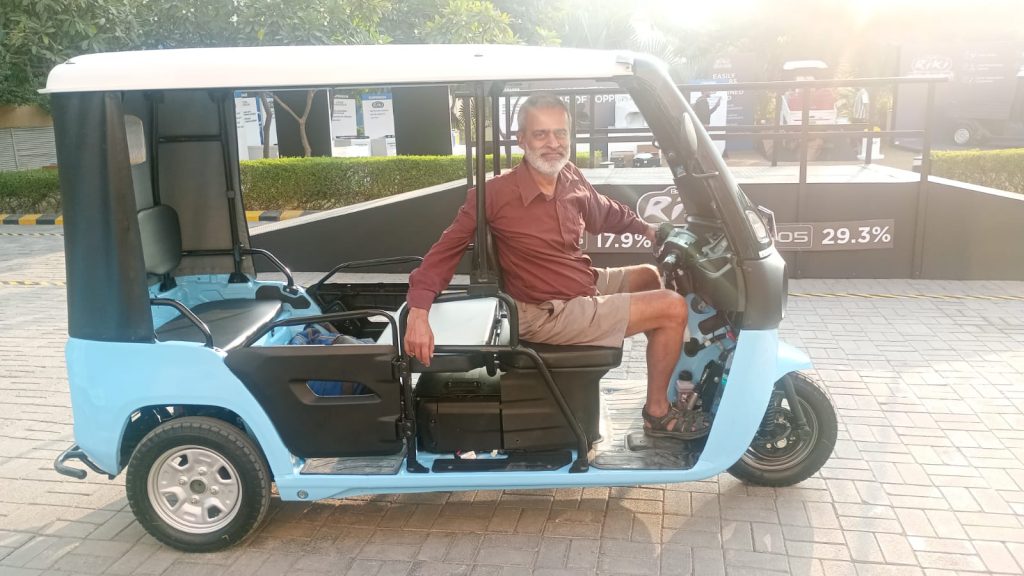
Passenger Riki
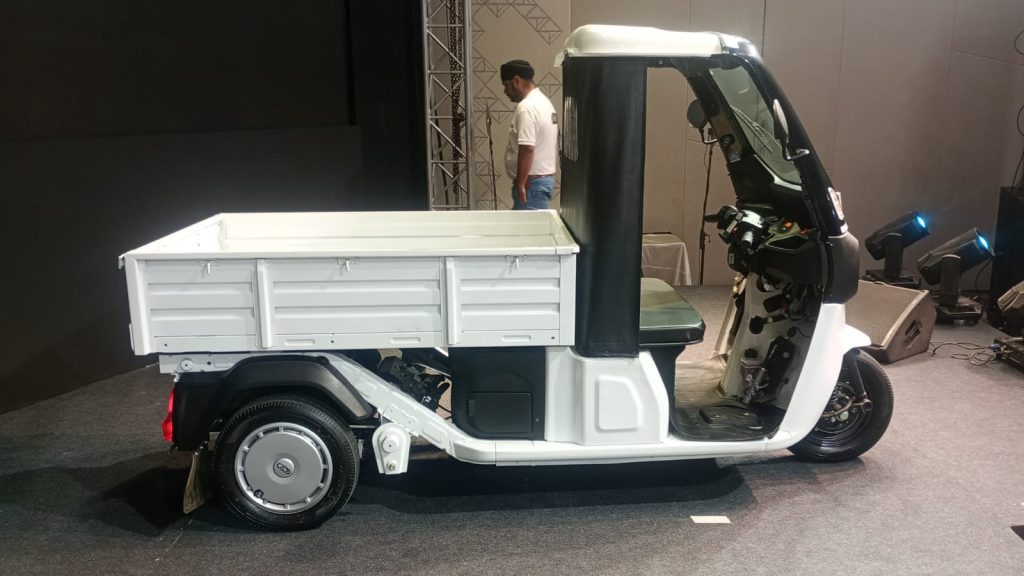
Cargo Riki
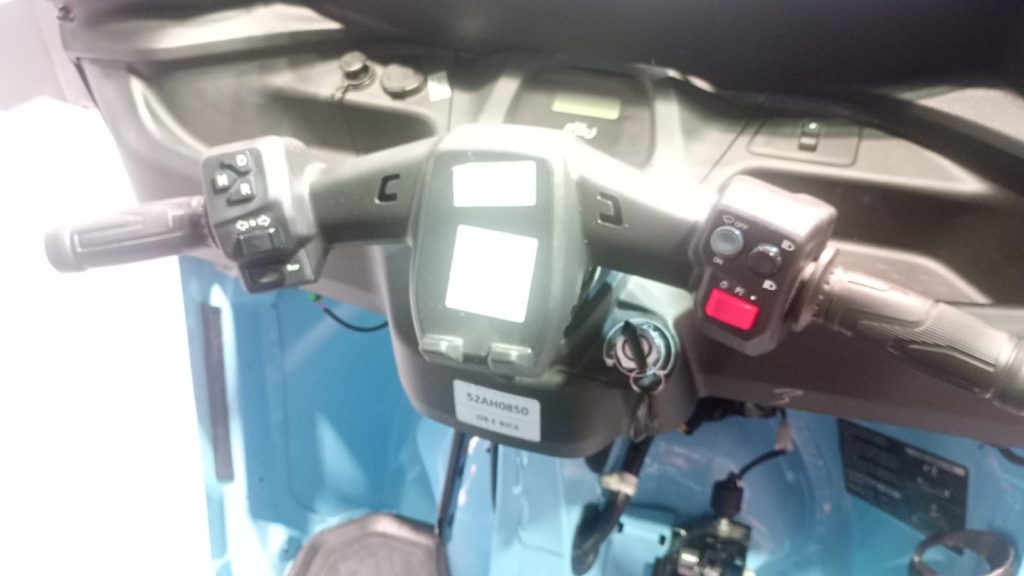
Handle bar
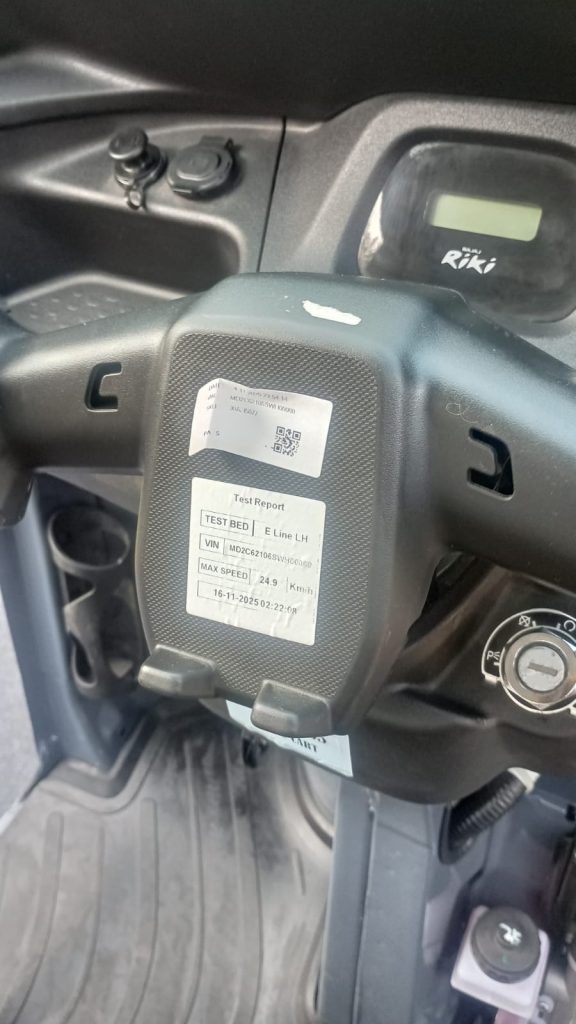
Nice place to park your phone – Note the rubber band slots
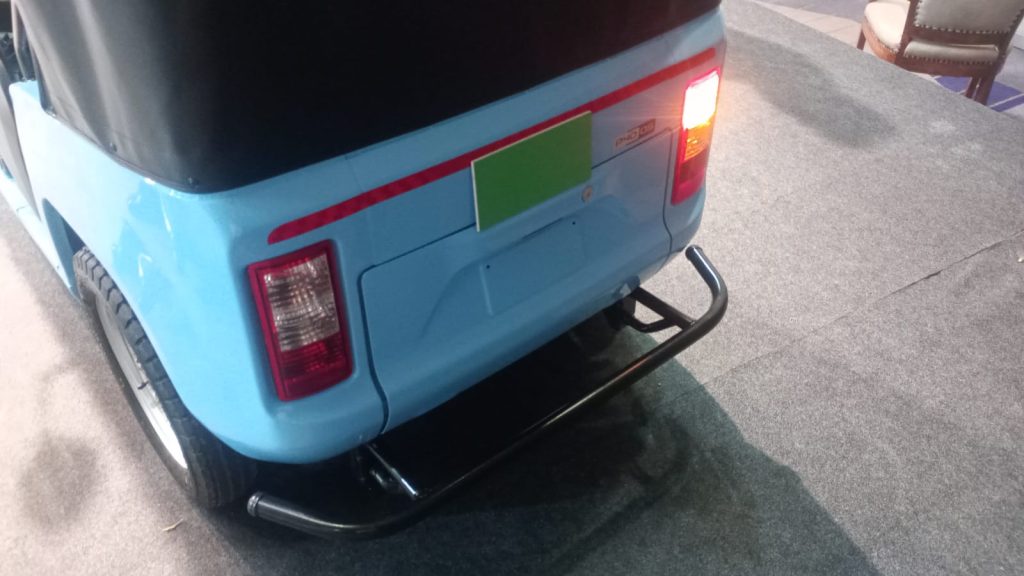
Passenger Stand cum Bumper?
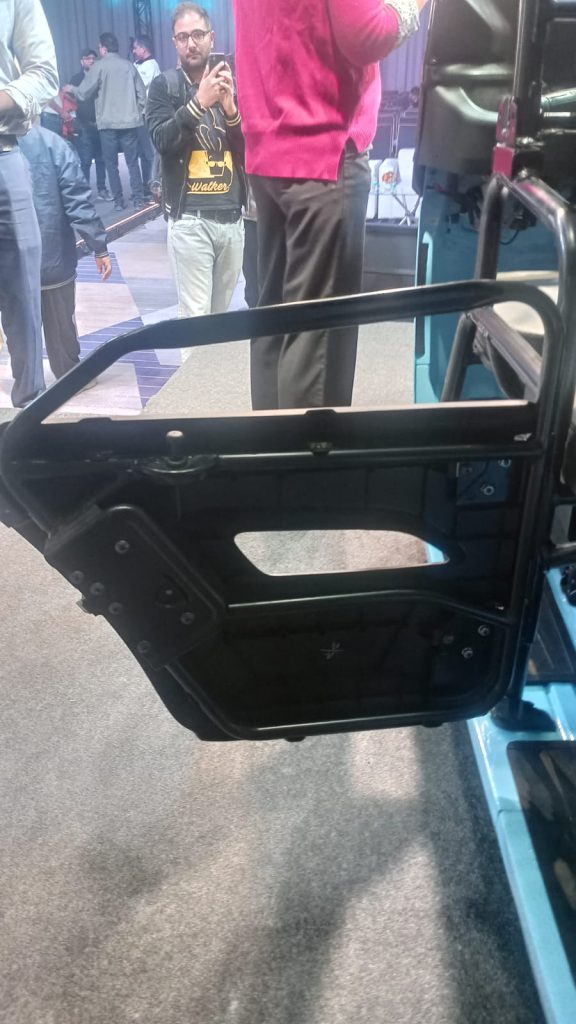
Door in tube frame with plastic casing
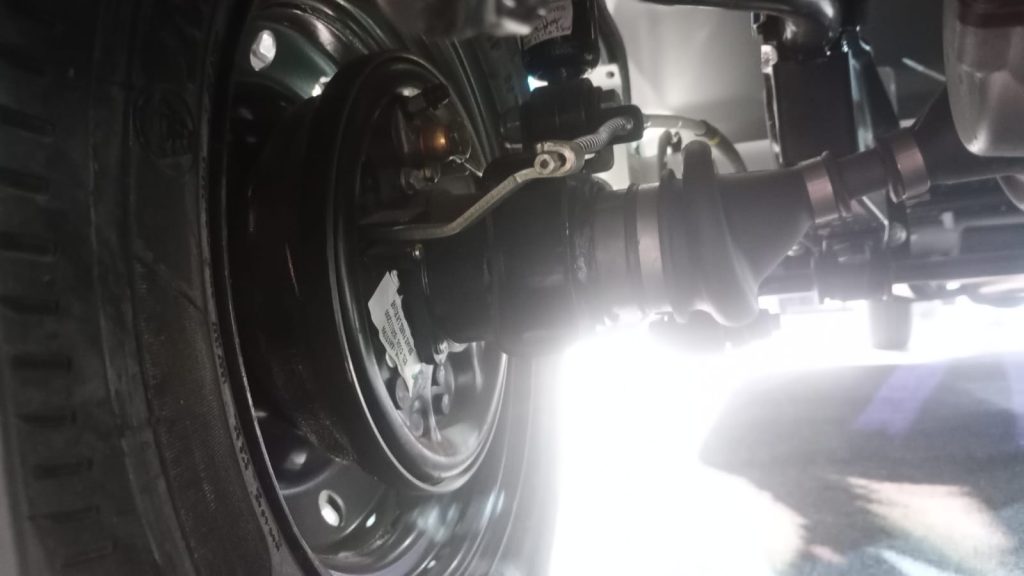
Drive shaft
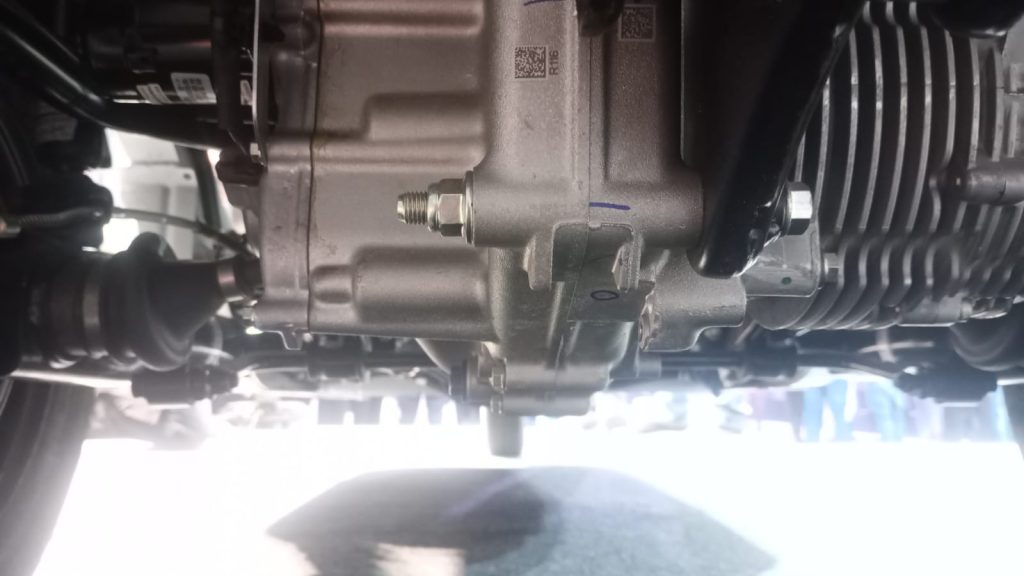
Motor
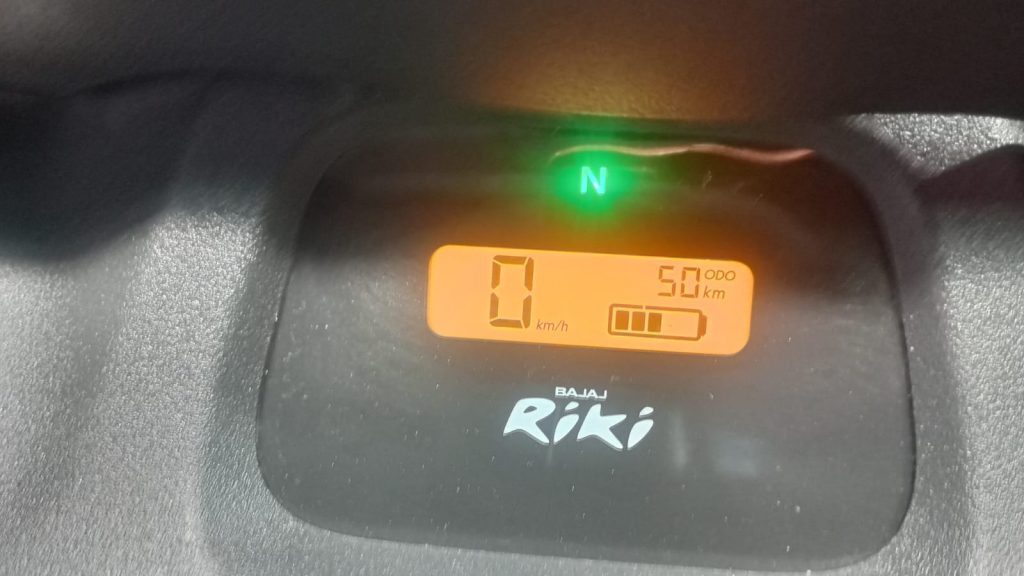
Cluster
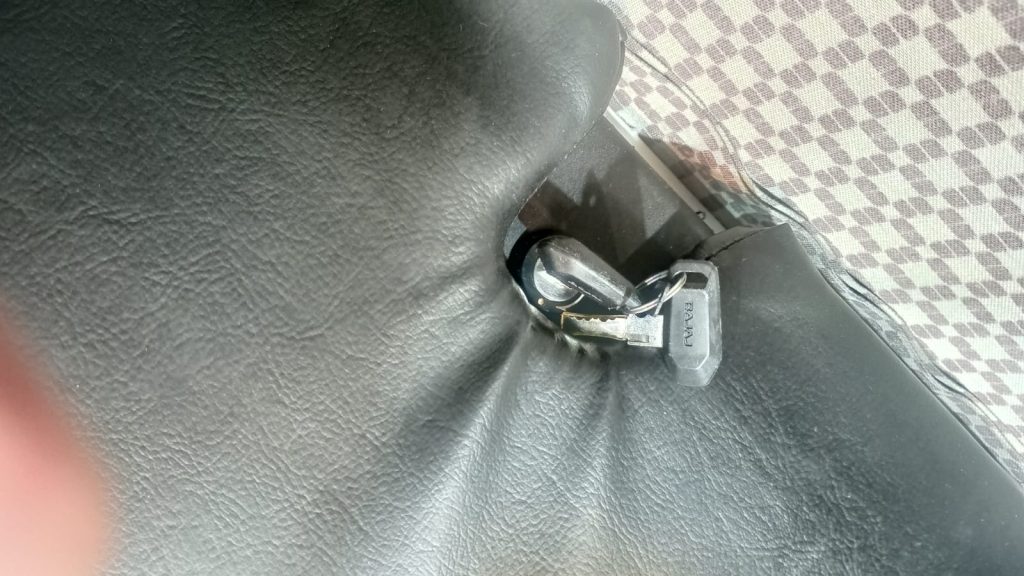
Underseat stowage locking
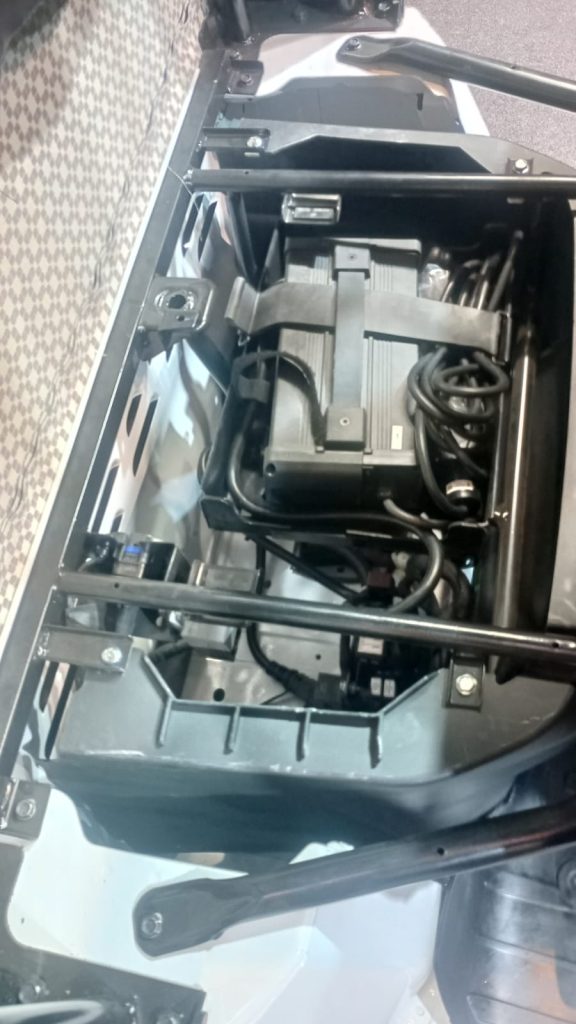
Charger storage area
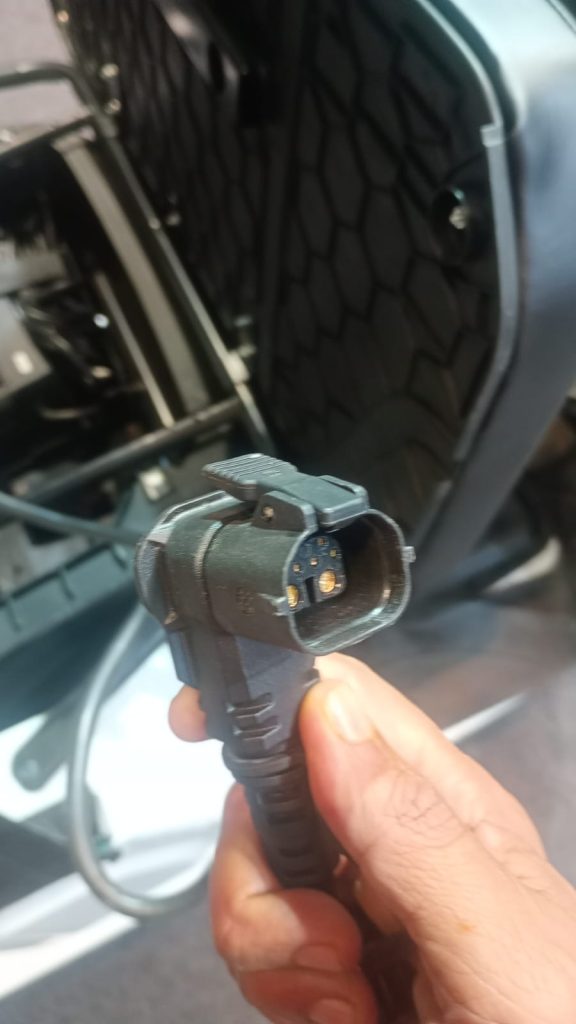
Battery charger connector
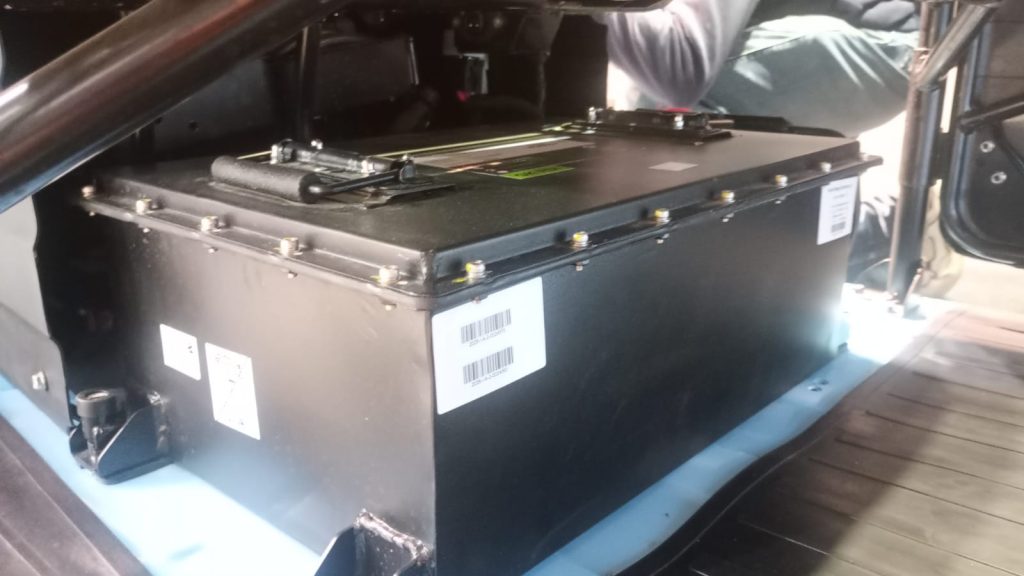
Passenger Riki Battery
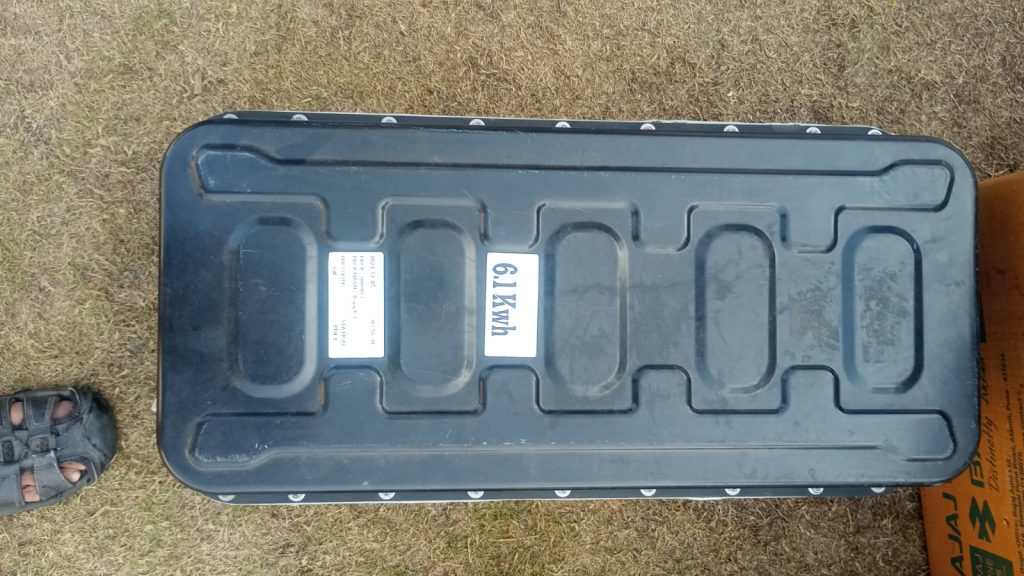
Cargo Riki Battery
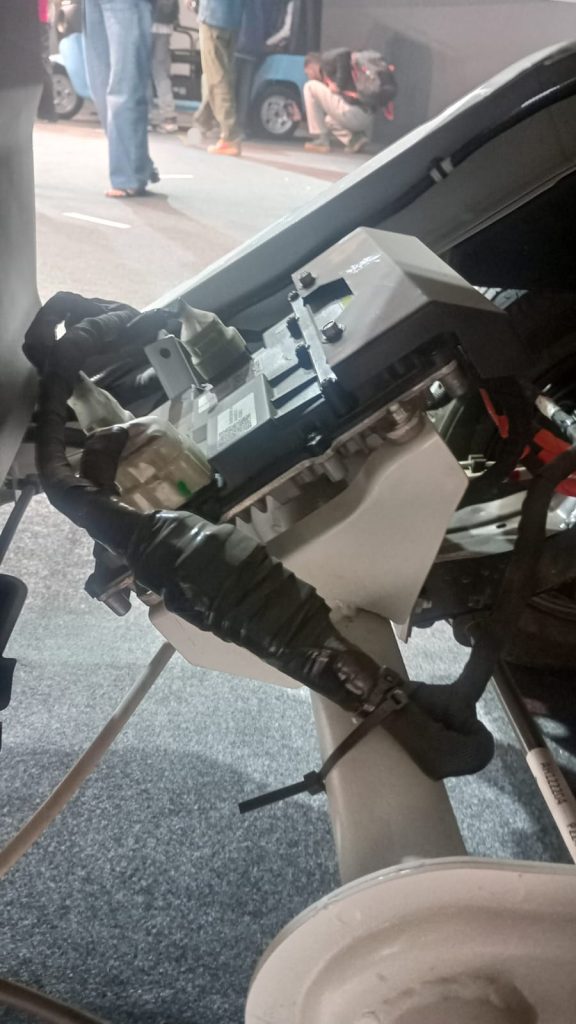
Exposed MCU in Cargo